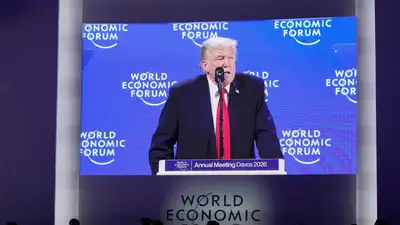
Greenland, Windmills, and the ‘Trump Peace’: A Fact-Check of the Dramatic Davos 2026 Speech
The World Economic Forum (WEF) in Davos is usually a stage for measured diplomacy and corporate networking. However, in January 2026, the atmosphere shifted from “quiet networking” to “stunned silence” as U.S. President Donald Trump delivered an explosive 70-minute address. From his relentless pursuit of Greenland to his recurring claims of stopping an India-Pakistan war, the speech has dominated Google Discover and global headlines.
For the UK audience, watching this unfold is a reminder of the “America First” doctrine’s unpredictable nature. Trump’s rhetoric at the summit was a mix of economic triumph, personal grievances against “enemies,” and a series of claims that have left fact-checkers working overtime.
The Greenland Obsession: Ownership or “Unstoppable Force”
The most significant takeaway from the 2026 Davos summit was Trump’s hardline push for the United States to acquire Greenland. He framed the autonomous Danish territory not as a country, but as a “strategic asset” and a “giant piece of ice” essential for American security against Russia and China.
Key highlights of his Greenland remarks include:
- No Force, but Direct Ownership: In a rare moment of de-escalation, Trump ruled out the use of military force to take the island, stating, “I won’t use force.” However, he insisted on “right, title, and ownership,” demanding immediate negotiations with Denmark.
- The “Ungrateful” Ally: Trump labeled Denmark as “ungrateful,” citing the U.S. defense of Greenland during World War II as a debt that has never been repaid. He even went so far as to call past U.S. leaders “stupid” for giving the territory back to Denmark after the war.
- The Iceland Confusion: In a bizarre twist that went viral on social media, Trump referred to Greenland as “Iceland” at least four times during his speech. This follows a similar slip-up at a recent White House press conference, leading to widespread mockery from European diplomats.
The India-Pakistan War: A Recurring Claim Under the Lens
A hallmark of Trump’s foreign policy narrative in 2026 is his insistence that he personally mediated a ceasefire between India and Pakistan. During his Davos address, he claimed to have “settled eight wars,” with the India-Pakistan conflict of 2025 being his crown jewel of diplomacy.
However, the facts on the ground tell a different story. Following India’s “Operation Sindoor” in May 2025—a series of precision strikes on terror infrastructure—India has consistently maintained that the cessation of hostilities was a bilateral agreement reached through the Directors General of Military Operations (DGMOs).
Fact-checking the “Trump Peace”:
- The 350% Tariff Threat: Trump claimed he forced both nations to the table by threatening 350% tariffs. While the U.S. did use economic pressure during that period, both New Delhi and Islamabad have officially denied any formal third-party mediation.
- The “Eight Wars” Narrative: Trump’s claim of settling eight wars within a single year has been met with skepticism. While he has been active in talks regarding Armenia-Azerbaijan and Ukraine, experts argue that labeling these “settled” is an oversimplification of complex, ongoing geopolitical tensions.
The War on Windmills: “Green New Scam” and Bird Grudges
True to his long-standing disdain for renewable energy, Trump used the Davos platform to launch a scathing attack on wind power. He branded the Green New Deal as the “Green New Scam” and described Europe’s reliance on windmills as a “great hoax.”
His critique of wind energy at Davos 2026 was largely focused on:
- The “Losers” of Europe: He claimed that windmills are “losers” that cost $1,000 every time they spin, asserting that energy should make money, not lose it.
- The China Connection: Trump alleged that China manufactures the “damn things” and sells them to “stupid people in Europe” while keeping its own energy production focused on fossil fuels.
- The Aesthetic and Environmental Grudge: He repeated his famous talking points about windmills “killing all the birds” and “ruining the landscape.” This specific grudge is widely believed to stem from his unsuccessful legal battle to stop an offshore wind farm near his Scottish golf course over a decade ago.
”America the Hottest”: The Economic Miracle Narrative
While his foreign policy and environmental remarks were polarizing, Trump used the first half of his speech to tout what he calls the “most significant economic turnaround of our century.” He claimed that one year into his second term, the U.S. has virtually eliminated inflation—a claim that current market data suggests is an exaggeration, though the U.S. economy has indeed shown resilience.
He described the U.S. as the “economic engine of the world” and warned that any country opposing his plans—specifically regarding Greenland—could face “remembered” consequences in future trade deals. For the UK, which is currently negotiating its own strategic space between the U.S. and the EU, this transactional approach to diplomacy poses a significant challenge.
Transatlantic Tension: NATO and the “One-Way Street”
The speech concluded with a stern warning to European allies. Trump described the current relationship with NATO as a “one-way street” where the U.S. pays for everything while receiving nothing but “unappreciated” silence. He claimed credit for forcing NATO members to spend 5% of their GDP on defense, a figure that far exceeds the official 2% target.
The reaction in the Davos hall was a mixture of laughter and visible discomfort. European Commission President Ursula von der Leyen, who spoke earlier in the week, had already signaled that Europe is pursuing “strategic independence” in response to these threats.
Conclusion: A Summit of Fragmentation
The 2026 Davos summit will be remembered not for global cooperation, but for the “Greenland and Windmills” speech that highlighted a deep fragmentation in the Western alliance. Trump’s blend of bravado, factual flexibility, and “America First” ultimatums has set a combative tone for the rest of the year.
As the world watches the fallout, the question remains: is this “unhinged” rhetoric a calculated negotiation tactic, or is it a sign of a permanent shift in how the United States interacts with its oldest friends?
Would you like me to provide a side-by-side comparison of Trump’s claims about the India-Pakistan ceasefire versus the official statements from the Indian Ministry of External Affairs?