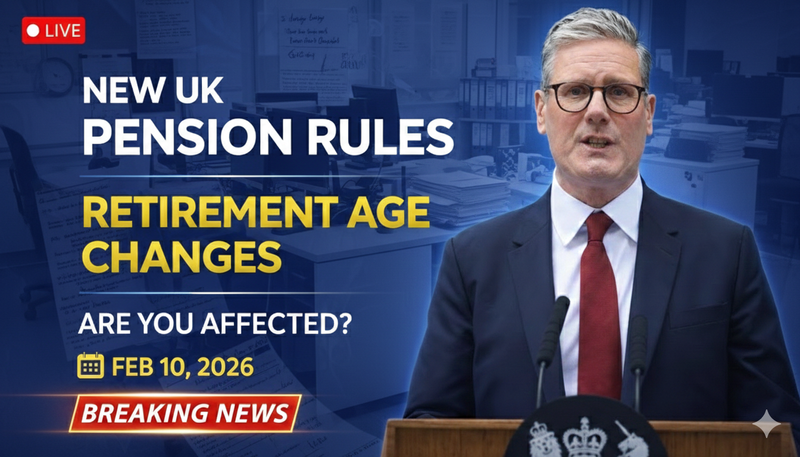
The British retirement landscape is undergoing one of its most significant shifts in decades. As we move through 2026, millions of workers across the United Kingdom are waking up to a new reality regarding their financial future. The “shock” being felt across the country isn’t just about a single date on a calendar; it is a fundamental transformation of how the State Pension functions, who qualifies for it, and when that first vital payment will actually land in a bank account.
For many, the dream of retiring at 65 is now a distant memory, replaced by a complex sliding scale of eligibility that reflects the UK’s aging population and the government’s struggle to keep the system sustainable. This article explores the intricate details of the 2026 updates, the legislative changes driving these shifts, and what you need to do right now to protect your golden years.
The 2026 Pivot: Why the State Pension Age is Climbing
The primary reason for the widespread concern is the scheduled transition of the State Pension age. Under current legislation, the age at which a UK citizen can claim their State Pension is rising from 66 to 67. While this change was planned years ago, the “shock” comes from the realization that the transition window is now firmly upon us.
Between 2026 and 2028, the age will gradually increase. This means if you were born after April 1960, you are likely looking at a longer wait than your predecessors. The Department for Work and Pensions (DWP) argues that because people are living longer, the system must adapt. However, for those in physically demanding jobs or those with health issues, another year of work can feel like an eternity.
The government’s rationale is built on the “Third of Adult Life” principle. The goal is for people to spend no more than one-third of their adult life in retirement. As life expectancy (despite recent plateaus) has historically trended upwards, the retirement age has followed suit to ensure the Treasury can actually afford to pay the bill.
The Impact on Different Generations
The 2026 rules do not hit everyone equally. The “shocks” are felt most acutely by two specific groups: those approaching retirement and the “middle-aged” workforce.
For those currently aged 64 and 65, the transition is a matter of immediate logistics. Many had planned their finances based on a 66-year-old exit strategy. Finding out they need to bridge a 12-month gap in income without the State Pension has sent many back to the drawing board. This often results in “pensioner poverty” risks for those without significant private savings.
For younger workers, the shock is more about the trajectory. Current reviews suggest that the move to 68 could happen much sooner than the originally planned 2040s. Some analysts predict that those currently in their 30s might not see a State Pension until they are 70 or 71. This creates a psychological barrier to retirement planning, leading to a “why bother” attitude that could be disastrous for long-term financial health.
Triple Lock Turmoil: Will It Survive 2026?
You cannot talk about UK pensions without mentioning the Triple Lock. This is the government’s promise to increase the State Pension every year by whichever is highest: earnings growth, inflation (CPI), or 2.5%.
In 2026, the Triple Lock remains a massive point of contention. While it provides a safety net against the rising cost of living, it is becoming increasingly expensive for the taxpayer. The “shock” for many is the constant rumor that the Triple Lock might be “modified” or scrapped to save billions.
If the Triple Lock were to be removed, the real-world value of the State Pension would likely erode over time. For millions of UK pensioners who rely on this as their primary source of income, even a small tweak to this formula could mean the difference between heating their homes or skipping meals. As of 2026, the commitment stands, but the political pressure to change it has never been higher.
Private Pensions and the 2026 “Gap”
Because the State Pension is moving further out of reach, the role of private and workplace pensions has become critical. The 2026 updates emphasize that the State Pension should be viewed as a “top-up” rather than a total solution.
Workplace pension auto-enrolment has been a success, but the “shock” for many is the realization that their current contribution levels are nowhere near enough. Most people are contributing the minimum (8% total), but experts suggest that to maintain a decent standard of living, that figure should be closer to 12% or 15%.
Furthermore, the “Normal Minimum Pension Age” (NMPA)—the earliest you can access your private pension—is also rising. It is set to increase from 55 to 57 in 2028. Many people in 2026 are realizing that if they wanted to retire early using their own savings, they have a very narrow window before the goalposts move again.
The Gender Pension Gap: A Growing Concern
The 2026 data continues to highlight a worrying trend: women are still being hit harder by pension changes. Due to career breaks for childcare, lower average wages, and the historical structure of the pension system, women often reach the new retirement age with significantly smaller private pots than men.
The increase in the State Pension age to 67 exacerbates this. Women often rely more heavily on the State Pension, making the delay in payment more impactful. Community groups and campaigners are calling for 2026 to be the year the government addresses this disparity, but for many women, the “shock” of a smaller-than-expected retirement income is already a reality.
Practical Steps to Navigate the 2026 Changes
If you are concerned about how these updates affect you, you shouldn’t wait for a letter from the DWP. Taking proactive steps is the only way to mitigate the impact of the rising retirement age.
First, check your State Pension forecast on the official GOV.UK website. This will tell you exactly when you will reach pensionable age and how much you are likely to receive based on your National Insurance record. You need at least 10 qualifying years to get any State Pension and 35 years to get the full amount.
Second, review your National Insurance (NI) record. If you have gaps—perhaps due to time spent abroad or periods of unemployment—you may be able to pay voluntary contributions to “plug” those gaps. In 2026, this remains one of the most cost-effective ways to boost your guaranteed retirement income.
Third, look at your workplace pension “Expression of Wish” forms and contribution levels. If you receive a pay rise in 2026, consider diverting a portion of it directly into your pension. Because of tax relief, a small sacrifice today can grow significantly by the time you reach 67.
The Future of Retirement in the UK
The New UK Pension Rules of 2026 are a wake-up call. The era of the “guaranteed early retirement” funded by the state is effectively over. The UK is moving toward a model where individuals must take more responsibility for their financial longevity.
While the “shock” of the age increase to 67 is significant, it is also an opportunity to re-evaluate what retirement looks like. Many people are choosing “phased retirement”—reducing their hours rather than stopping work entirely. This helps bridge the gap until the State Pension kicks in and keeps retirement pots growing for longer.
As we look beyond 2026, the conversation will inevitably turn to the sustainability of the system. Will the age hit 70 by the 2050s? Will the State Pension become means-tested? These are the questions that will dominate the next decade of British politics.
Final Thoughts for UK Workers
The 2026 retirement age update is a reminder that the only constant in pension planning is change. Millions are shocked because the safety net they expected is shifting beneath them. However, by staying informed, checking your forecasts, and maximizing your private contributions, you can build a retirement that is defined by your choices, not just by government policy.
The “shocks” of today can be managed with the planning of tomorrow. Ensure you are taking advantage of all available tax reliefs and employer matches, and keep a close eye on further government reviews. Your future self will thank you for the attention you pay to these rules today.