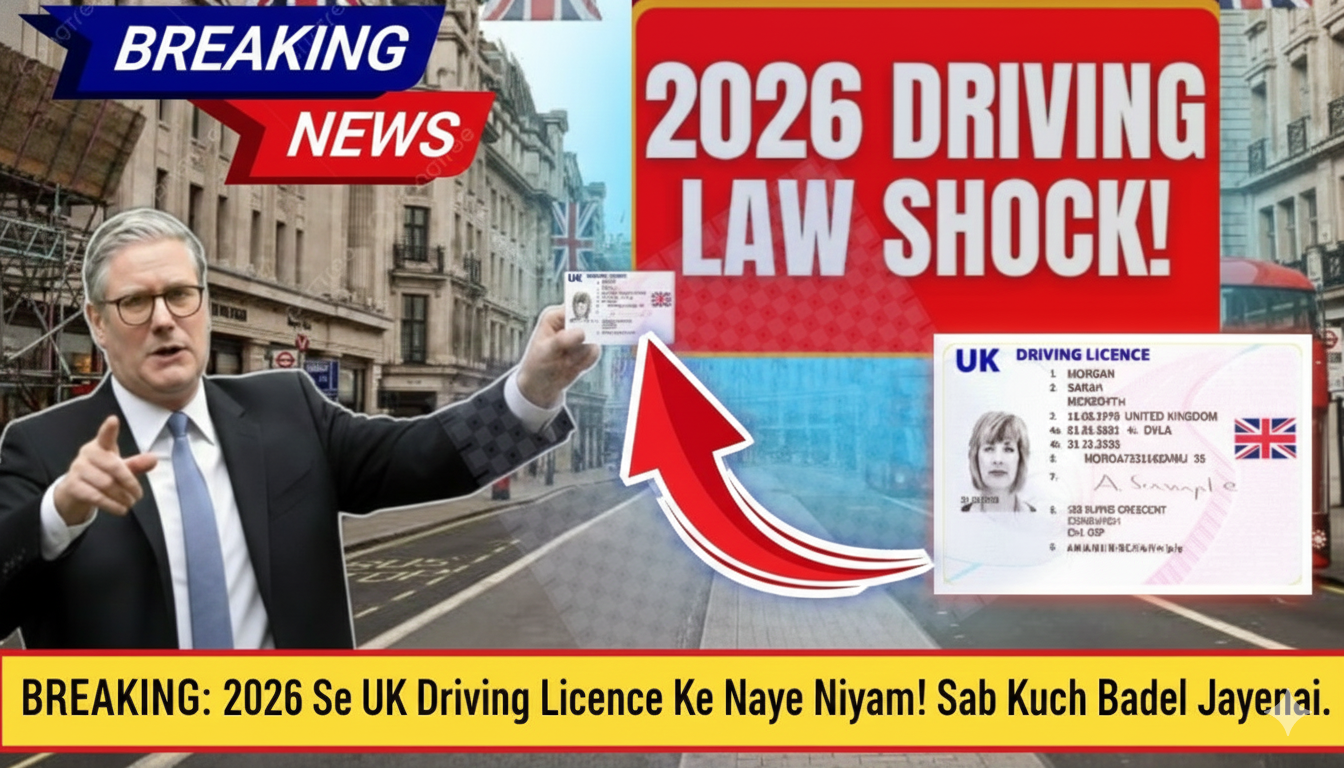
UK Driving Rules 2026: New Law Changes Explained & How to Apply Step by Step
The landscape of British motoring is set for a monumental shift as we head into 2026. Whether you are a seasoned driver with decades of experience or a learner eager to get your first set of wheels, the upcoming changes to UK driving laws will impact almost everyone on the road. From stricter safety regulations to the evolution of digital licensing, the Department for Transport (DfT) and the DVLA are rolling out updates designed to make UK roads the safest in the world.
Staying informed is no longer just a recommendation; it is a necessity to avoid heavy fines and points on your licence. In this comprehensive guide, we break down every major change expected in 2026 and provide a fresh, step-by-step look at the modern application process for new drivers.
H2 Major Driving Law Changes Coming in 2026
The government has signaled a “zero-tolerance” approach to road safety for 2026. Several key areas are under review, and some have already been confirmed for rollout.
Stricter Medical Declarations and Eyesight Checks for Older Drivers are at the top of the agenda. Starting January 2026, the DVLA is introducing a more rigorous process for motorists aged 65 and over. While there is no automatic ban, the days of simply “ticking a box” to self-certify fitness are ending. Drivers will face more detailed questions regarding heart conditions, diabetes, and epilepsy. Furthermore, there is a renewed emphasis on the “20-metre number plate test.” If a driver cannot read a plate from this distance, their licence renewal may be refused immediately.
Tougher Penalties for Seatbelt Offences and AI Camera Enforcement will also define 2026. The government is moving beyond simple fines. New AI-powered roadside cameras are being deployed across the UK to detect drivers and passengers not wearing seatbelts. From 2026, repeat offenders could face penalty points on their licence in addition to the standard £500 fine. This is a significant shift aimed at reducing the high percentage of road fatalities linked to unrestrained occupants.
Intelligent Speed Assistance (ISA) as a Standard is another technical milestone. While this rule began for new models in 2024, by 2026, virtually every brand-new vehicle on UK forecourts will feature factory-fitted speed limiters. These systems use GPS and cameras to read speed signs and can automatically reduce engine power if you exceed the limit. Although drivers can manually override the system, it will reactivate every time the car is started.
H2 The End of Tax-Free Electric Motoring
2026 marks the first full year where Electric Vehicle (EV) owners will feel the pinch of Vehicle Excise Duty (VED). For years, EVs were exempt from road tax to encourage the transition to green energy.
Starting from the 2025/2026 tax year, zero-emission cars are no longer exempt. New EV owners will pay a first-year rate of £10, which then jumps to the standard rate of £195 in the second year. Even more critical for luxury car buyers is the “Expensive Car Supplement.” If your electric car has a list price exceeding £40,000, you will be liable for an additional surcharge of roughly £410 per year for five years. This effectively levels the playing field between petrol, diesel, and electric vehicle running costs.
H2 New Booking Rules for Learner Drivers in 2026
The Driver and Vehicle Standards Agency (DVSA) has confirmed a major overhaul of the driving test booking system, set to go live in Spring 2026. These changes are designed to tackle the massive backlog and discourage “test swapping” by third-party bots.
Under the new 2026 rules, only the learner driver will be allowed to book their own practical test; instructors will no longer have the authority to book on a pupil’s behalf. Furthermore, learners will be restricted to a maximum of two changes to their appointment. If you need to change your date or location a third time, you will be forced to cancel the booking and start from scratch. This move aims to ensure that only those truly ready for their test are taking up valuable slots.
H2 How to Apply for Your UK Driving Licence in 2026: Step by Step
Applying for a licence in 2026 is a digital-first process. Follow these steps to ensure a smooth application.
Step 1: Check Your Eligibility
Before applying, ensure you meet the residency requirements. You must have lived in the UK for at least 185 days in the last 12 months. You can apply for a provisional licence at 15 years and 9 months, though it only becomes valid for driving a car when you turn 17.
Step 2: Prepare Your Digital Identity
The DVLA now prioritizes applications verified via the “GOV.UK One Login” system. You will need a valid UK passport (biometric), your National Insurance number, and a history of your addresses for the last three years. Applying online is faster and costs £34, compared to £43 for postal applications.
Step 3: The Theory Test and Hazard Perception
Once you have your provisional green card, book your theory test. In 2026, the hazard perception part of the test features more diverse “CGI” scenarios, including night driving and adverse weather conditions. You must pass this before you can even look at booking a practical date.
Step 4: Managing Your Practical Test Booking
Use the official DVSA portal. Be wary of “cancellation apps” that charge high fees. In 2026, the DVSA has strengthened its firewall against these services. If you fail your test, you must now wait 28 working days before you can book another attempt, a rule designed to encourage more practice between tries.
Step 5: Upgrading to a Full Licence
After passing your practical test, your examiner will send your details to the DVLA electronically. Your full pink photocard usually arrives within 3 weeks. By late 2026, the UK plans to have the “Digital Driving Licence” fully integrated into a government app, allowing you to prove your driving status using your smartphone, though keeping the physical card is still legally required for travel abroad.
H2 Changes for Van and HGV Drivers
The commercial sector is not immune to 2026 updates. A new “Mobility Package” influence means that smaller vans (over 2.5 tonnes) used for cross-border transport into Europe will now require “smart tachographs.” This is to monitor driving hours and ensure safety standards are maintained across the industry. Additionally, HGV drivers will see more rigorous enforcement of “Direct Vision Standards” (DVS) in major cities like London, where cameras will automatically fine vehicles that do not meet visibility requirements to protect cyclists and pedestrians.
H2 Final Verdict for UK Motorists
As we navigate through 2026, the theme is clear: accountability. With AI cameras, speed limiters, and stricter medical checks, the government is leveraging technology to reduce human error. For the average driver, this means higher costs through new EV taxes and a greater need to stay sharp on the Highway Code.
Inhe aap apne article mein H2 aur H3 tags ke roop mein use kar sakte hain:
Full Article Structure & Topics (UK Driving 2026)
Topic 1: The Big Picture: Why UK Driving Laws are Changing in 2026
Sub-topic: The Government’s “Vision Zero” strategy for road safety.
Sub-topic: How AI and technology are taking over road enforcement.
Topic 2: Major Changes to Driving Licences and Renewals
Sub-topic: New mandatory health checks for drivers over 65.
Sub-topic: The end of self-certification: Why eye tests are now crucial.
Sub-topic: Digital Driving Licences: Will the plastic card become a thing of the past?
Topic 3: The 2026 Electric Vehicle (EV) Tax Shock
Sub-topic: Understanding the new Vehicle Excise Duty (VED) for EVs.
Sub-topic: The £40,000 “Luxury Car” supplement explained.
Sub-topic: How much more will you pay? A breakdown of costs.
Topic 4: New Safety Tech and AI Enforcement
Sub-topic: AI Cameras: Detecting seatbelts and mobile phone use from miles away.
Sub-topic: Intelligent Speed Assistance (ISA): How your car will now control your speed.
Sub-topic: Smart Motorways 2026: The rollout of SVD (Stopped Vehicle Detection).
Topic 5: Stricter Penalties and Fines
Sub-topic: The push for lower drink-drive limits in England and Wales.
Sub-topic: Penalty points for seatbelt offences: A new deterrent.
Sub-topic: Increased fines for driving without valid insurance.
Topic 6: The 2026 Application Process for New Drivers (Step-by-Step)
Sub-topic: Applying for a Provisional Licence via the ‘One Login’ system.
Sub-topic: Changes to the Theory Test: New CGI hazard scenarios.
Sub-topic: The 28-day re-booking rule: Why failing your test just got more expensive.
Topic 7: Professional and Commercial Driving Updates
Sub-topic: New Tachograph rules for vans (2.5 tonnes+).
Sub-topic: Direct Vision Standards (DVS) for HGVs in major UK cities.
Topic 8: Conclusion and Driver Checklist
Sub-topic: How to stay compliant and avoid points in 2026.
Sub-topic: Final verdict: Is it getting harder to drive in the UK?