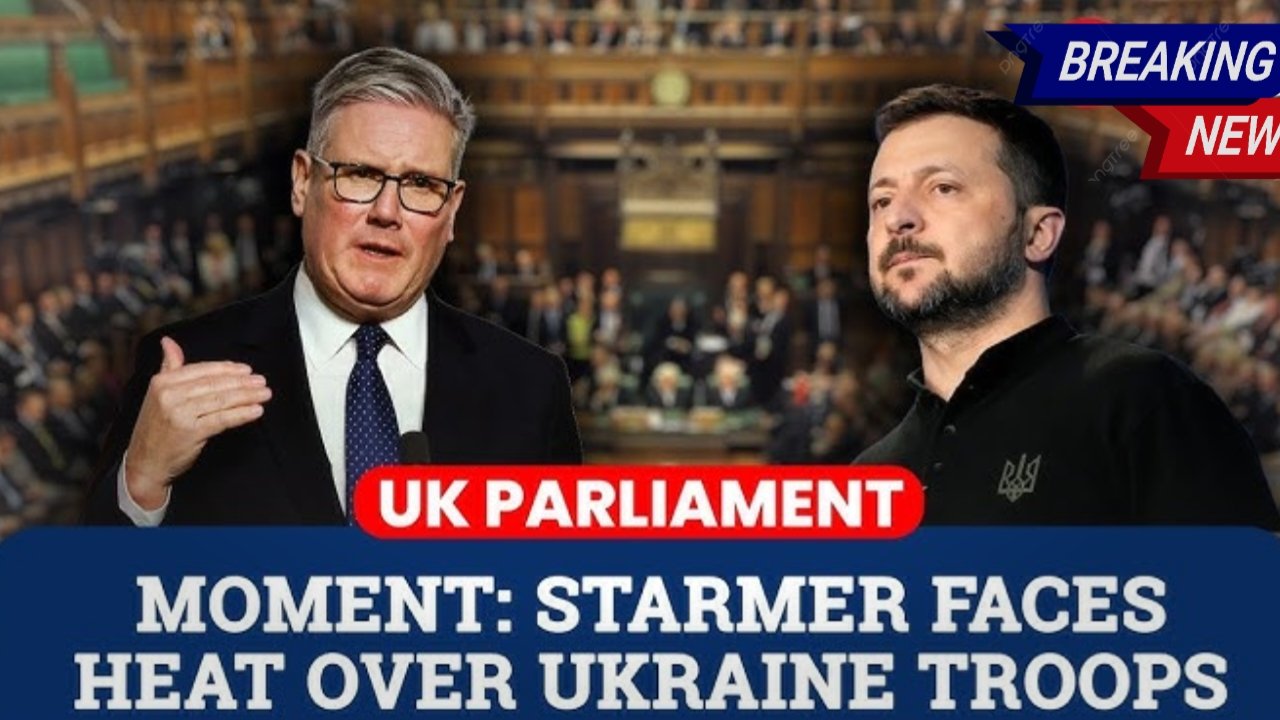
UK Prime Minister Keir Starmer stated that any deployment of British troops to Ukraine would only occur after a ceasefire and require a parliamentary vote. This followed a declaration of intent with France for security guarantees and military hubs.
In a significant shift in British foreign policy, Prime Minister Keir Starmer has confirmed that the UK is prepared to deploy ground troops to Ukraine. This monumental decision, however, comes with strict conditions: a confirmed ceasefire must be in place, and the British Parliament must have the final say through a democratic vote.
This announcement follows a high-stakes summit in Paris where the “Coalition of the Willing” met to discuss the future of European security. Side-by-side with French President Emmanuel Macron and Ukrainian President Volodymyr Zelenskyy, Starmer signed a “declaration of intent” that outlines a post-war landscape where British and French forces play a central role in maintaining peace.
The Paris Declaration: A New Security Era
The agreement signed in Paris is not merely a symbolic gesture; it is a strategic roadmap. The declaration envisions a “Multinational Force for Ukraine” that would operate on Ukrainian soil to provide security guarantees that have, until now, been largely theoretical.
The core of this plan involves the establishment of Anglo-French “military hubs” across Ukraine. These hubs are intended to be more than just barracks. They are designed to be protected facilities where weapons and military equipment can be produced locally, reducing Ukraine’s reliance on long-distance supply chains and bolstering its own defensive industrial base.
For the UK, this represents the most significant potential military commitment in Europe since the end of the Cold War. It signals a move away from providing only equipment and training towards a physical presence intended to deter future Russian aggression.
The Condition of a Ceasefire
Keir Starmer has been very clear that British “boots on the ground” will not be sent into an active combat zone. The Prime Minister told the House of Commons that deployment would “only occur after a ceasefire.”
The logic behind this condition is two-fold. Firstly, it avoids a direct military confrontation between NATO forces and Russia, which could lead to a catastrophic escalation. Secondly, it frames the British mission as one of “deterrence and regeneration” rather than active warfare.
- The role of British troops, as described by Downing Street, would be to:
- Support Ukraine’s long-term defensive capabilities.
- Conduct deterrence operations to ensure Russia does not break the peace.
- Protect the newly established military hubs and critical infrastructure.
- Retrain and rebuild the Ukrainian armed forces to modern NATO standards.
- Parliament’s Role: The Vote on Deployment
In a move to ensure constitutional transparency and public support, Starmer has pledged that any deployment will be subject to a vote in the House of Commons. “Were troops to be deployed under the declaration signed, I would put that matter to the House for a vote,” he stated during Prime Minister’s Questions.
This commitment is crucial for the Labour government, as it places the responsibility for such a historic decision on the shoulders of all elected MPs. It follows a precedent where major military actions—such as the 2013 vote on Syria—are debated and decided in the chamber rather than solely by the executive.
The Prime Minister has promised that before any vote takes place, the government will provide clear details on the number of personnel involved and the specific nature of their mission. Current estimates and reports suggest the force could number several thousand, with some reports indicating the UK might contribute up to 7,500 troops to the multinational effort.
Domestic Political Reaction and Opposition
While the Prime Minister framed the agreement as a step toward “just and lasting peace,” the announcement has met with a mix of support and sharp criticism from across the political spectrum.
Kemi Badenoch, leader of the Conservative Party, questioned why a full statement wasn’t made to Parliament immediately after the Paris summit. She accused the Prime Minister of a “lack of respect” for MPs, demanding clarity on whether the troops would ever be in combat roles.
On the other hand, Nigel Farage, leader of Reform UK, has already signaled his opposition. He argued that the UK has neither the “manpower nor the equipment” for such a long-term commitment and warned of an operation with “no ending timeline.”
Even within the House of Commons Defence Committee, concerns have been raised. Chairman Tan Dhesi noted that while the move cements the UK’s position as a defender of Ukraine, it risks overstretching a British Army that is already at its smallest size in over 200 years—recently falling to just over 70,000 personnel.
The International Context: US and European Allies
The UK and France are not acting in a vacuum. The Paris summit included representatives from the United States, including special envoys Steve Witkoff and Jared Kushner. The US has indicated support for “security protocols” and a ceasefire monitoring mechanism that would likely utilize drones and satellites.
However, there remains a distinction between the European and American approaches. While the UK and France are preparing for a physical presence, the US has so far been more cautious about committing ground forces, focusing instead on being a “backstop” for security guarantees and economic rebuilding.
Other European nations are also weighing their options. German Chancellor Friedrich Merz suggested that German forces might be deployed to NATO territory neighboring Ukraine rather than directly onto Ukrainian soil, highlighting the varying levels of risk appetite among allies.
What This Means for the Future of Ukraine
For President Zelenskyy, the Anglo-French declaration is a “substantive” step toward real security. Ukraine has long argued that “paper guarantees” are not enough to prevent another Russian invasion. The presence of British and French troops would act as a “tripwire,” making any future Russian aggression a direct challenge to two of Europe’s major nuclear powers.
The establishment of military hubs also marks a shift toward the “Israel model” of security—where Ukraine becomes so well-armed and industrially self-sufficient that the cost of attacking it becomes too high for any aggressor to bear.
Challenges and Risks Ahead
The path to deployment is fraught with challenges. The most obvious is the lack of a current ceasefire. Despite the diplomatic flurry in Paris, fighting on the front lines remains intense, and Russia has repeatedly stated its opposition to any Western military presence in Ukraine, labeling such forces as “legitimate targets.”
There is also the question of the “legal instrument” Starmer mentioned. For British troops to operate legally in a foreign country after a war, a complex framework of Status of Forces Agreements (SOFA) must be negotiated.
Furthermore, the British public’s appetite for a long-term military commitment in Eastern Europe remains untested. While support for Ukraine remains high, the memory of long-term deployments in Iraq and Afghanistan still lingers in the national psyche.
Conclusion: A Pivot Point for British Defence
The decision by Keir Starmer to commit British troops to a post-war Ukraine marks a pivot point in the UK’s global role. It signals that Britain is prepared to take a leading role in European security, even as the geopolitical landscape becomes increasingly unpredictable.
By conditioning the move on a ceasefire and a parliamentary vote, the government is attempting to balance the need for strong deterrence with the requirements of democratic accountability and military pragmatism.
The coming months will be critical. As military planners in London and Paris draw up the details of these “military hubs” and “deterrence operations,” the world will be watching to see if this declaration of intent can be transformed into a reality that finally brings stability to the European continent.
Would you like me to analyze how this deployment might affect the current size and budget of the British Army?