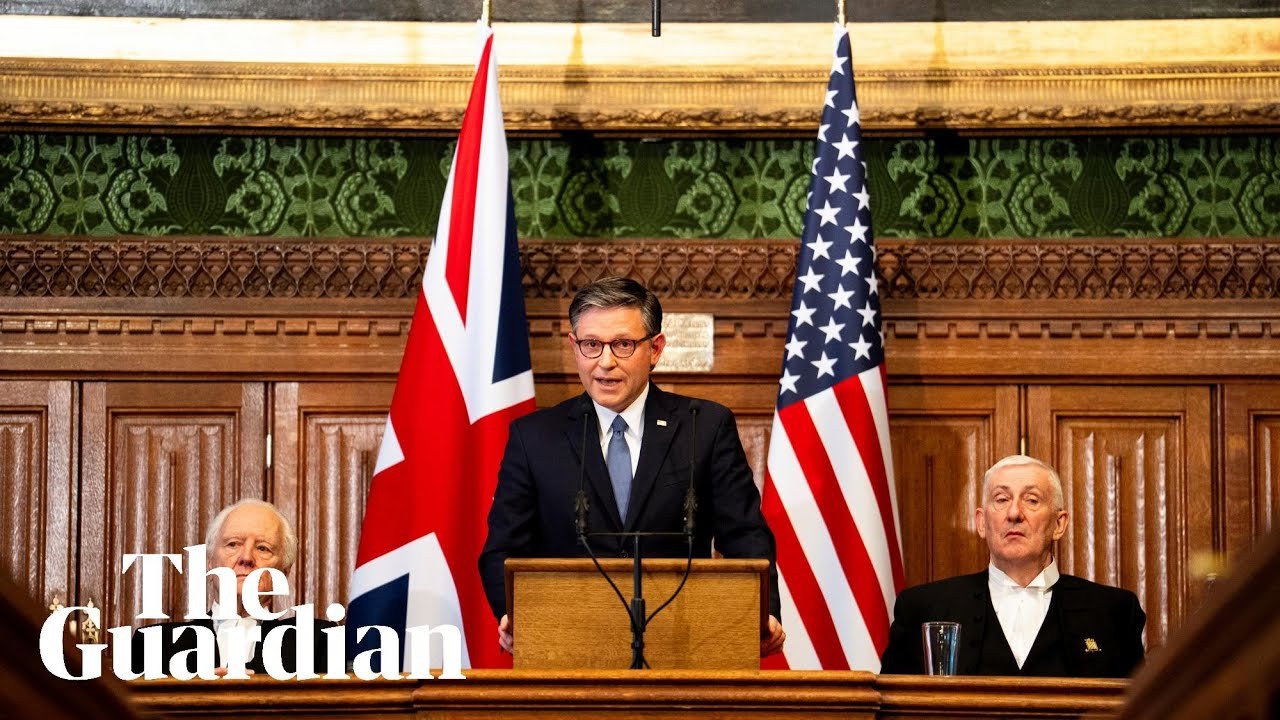
US Speaker Mike Johnson in London: A Mission to ‘Calm the Waters’ Amidst Transatlantic Turbulence
The “Special Relationship” between the United Kingdom and the United States has often been described as the bedrock of Western security, but rarely has it faced a week as chaotic as this one in January 2026. As President Donald Trump’s rhetoric regarding Greenland and trade tariffs sent shockwaves through European capitals, U.S. House Speaker Mike Johnson arrived at the Palace of Westminster with a singular, high-stakes objective: to “calm the waters.”
In a historic address—the first ever by a sitting U.S. House Speaker to the British Parliament—Johnson sought to bridge the widening gap between the White House’s “America First” agenda and the anxieties of its oldest ally. For the UK audience, the speech was a masterclass in diplomatic tightrope-walking, attempting to reassure MPs of America’s commitment to its partners while simultaneously defending the underlying logic of the Trump administration’s aggressive new foreign policy.
The Greenland Crisis and the Threat of Tariffs
The timing of Speaker Johnson’s visit could not have been more delicate. Only days prior, President Trump had stunned the international community by renewing his demand for the acquisition of Greenland, the semi-autonomous Danish territory. When Denmark and its European allies, including the UK, expressed firm opposition to the idea, Trump retaliated with a threat that hit the UK right in its economic pocket: a 10% tariff on all imports from countries that “obstruct” the American security interest in the Arctic.
For Prime Minister Keir Starmer’s government, this was a moment of profound jeopardy. The UK, already navigating a fragile post-Brexit economic landscape, found itself caught between its desire for a stable trade relationship with the US and its commitment to international law and territorial sovereignty. Speaker Johnson’s mission was to ensure that this “rift,” as he called it, did not escalate into a full-blown trade war.
”America First” Does Not Mean “America Alone”
A central theme of Johnson’s address was the reframing of the “America First” doctrine. Addressing the House of Commons and the House of Lords, Johnson insisted that the United States is not retreating into isolationism. Instead, he argued that a stronger, more assertive America is the only force capable of maintaining global stability against a “new axis of adversaries.”
He spent significant time detailing the “modern and dynamic threats” posed by China, Russia, and Iran. Johnson specifically linked the Greenland issue to these security concerns, arguing that President Trump’s focus on the Arctic is driven by the need to prevent Russian and Chinese expansion in the region. To Johnson, the acquisition of Greenland is not a “colonial” land grab, as some EU leaders have claimed, but a strategic necessity for the collective defense of the West.
The Chagos Islands Controversy: Trump’s “Great Stupidity” Remark
Adding further fuel to the fire, just hours before Johnson took the podium, President Trump took to social media to blast the UK’s recent agreement to cede sovereignty of the Chagos Archipelago to Mauritius. Trump labeled the deal—which includes the joint US-UK airbase at Diego Garcia—an “act of GREAT STUPIDITY.”
The criticism was particularly stinging because the Starmer government had viewed the deal as a way to secure the long-term future of the base while following international legal rulings. Johnson had the unenviable task of smoothing over these insults. While he did not directly contradict the President, he praised Prime Minister Starmer’s “calm and professional” approach to the disagreement, suggesting that the two nations have a long history of working through even the most vitriolic differences.
A Shared Cultural and Historical Anchor
To ground his message of reassurance, Johnson leaned heavily on the shared history and values of the two nations. His visit was originally planned to commemorate the 250th anniversary of American independence from British rule—a milestone he used to highlight how far the relationship has come. He described London as the “spiritual birthplace” of the American nation, citing the influence of British thinkers on the US Constitution.
He invoked the names of iconic leaders who symbolised the transatlantic bond:
- Winston Churchill and Franklin D. Roosevelt: Reminding the audience of the cooperation that won World War II.
- Margaret Thatcher and Ronald Reagan: Appealing to the conservative roots of the “Special Relationship” and their shared fight against communism.
- Abraham Lincoln: Drawing parallels to the resilience required during times of domestic and international upheaval.
By framing the current tensions as a temporary “awkward time” in a centuries-long partnership, Johnson aimed to lower the temperature in Westminster.
The “Menacing Scepticism” of Modern History
In a segment of the speech that resonated with the more conservative members of the UK Parliament, Johnson delivered a sharp critique of what he called “liberal and leftist thought” in Western institutions. He spoke of a “menacing scepticism” towards national history and institutions, arguing that the youth in both the US and the UK are being taught to view their countries “only through the lens of their sins.”
This cultural appeal served a dual purpose: it reinforced his credentials as a Republican leader and suggested a shared civilizational struggle that transcends trade disputes or territorial arguments. He called for a return to “civilizational pride” and “strong borders,” themes that have become central to the right-wing political discourse on both sides of the Atlantic in 2026.
The Diplomatic Fallout: What Happens Next?
Despite Johnson’s soothing words, the fundamental disagreements remain. European leaders, currently gathering at the World Economic Forum in Davos, have largely condemned the US stance on Greenland as “new colonialism.” The European Commission has already begun drafting a list of retaliatory measures should Trump follow through on his tariff threats.
In the UK, the response to Johnson’s speech was divided. While some welcomed the reassurance and the promise of dialogue, others viewed it as “diplomatic wallpaper” that fails to hide the structural damage Trump’s policies are doing to the NATO alliance.
The next few weeks will be critical. President Trump is expected to address the Davos summit on Wednesday, where he will likely double down on his “transactional” view of alliances. Whether Speaker Johnson’s mission to “calm the waters” has succeeded or if he merely provided a brief respite before a larger storm remains to be seen.
The Strategic Importance of Diego Garcia
One of the most complex layers of this diplomatic puzzle is the status of Diego Garcia. The UK government maintains that the 99-year lease secured in the Chagos deal provides the “ultimate security” for US and UK interests. However, Trump’s latest outburst suggests the White House may no longer trust London to manage its overseas territories effectively. This could lead to a push for even more direct American control over strategic sites around the world, further straining the concept of British sovereignty.
Conclusion: Rebuilding the Bridge
Speaker Mike Johnson’s visit was a reminder that even in an era of “America First,” the US recognizes the value of having a reliable “bridge” to Europe. By speaking to the UK Parliament, he acknowledged that London remains Washington’s most important conduit to the rest of the continent.
However, “calming the waters” is only the first step. The real challenge will be found in the coming negotiations over Arctic security, trade tariffs, and the future of NATO. As Johnson himself noted, the two nations must “look to agreement and continue our dialogue,” but in 2026, the price of that agreement may be higher than it has ever been.
Would you like me to create a detailed timeline of the US-UK diplomatic exchanges regarding the Greenland and Chagos issues throughout this month?
Speaker Mike Johnson addresses UK lawmakers
This video provides the full footage of the historic session where the Speaker laid out his mission to reassure British politicians and maintain the special relationship.