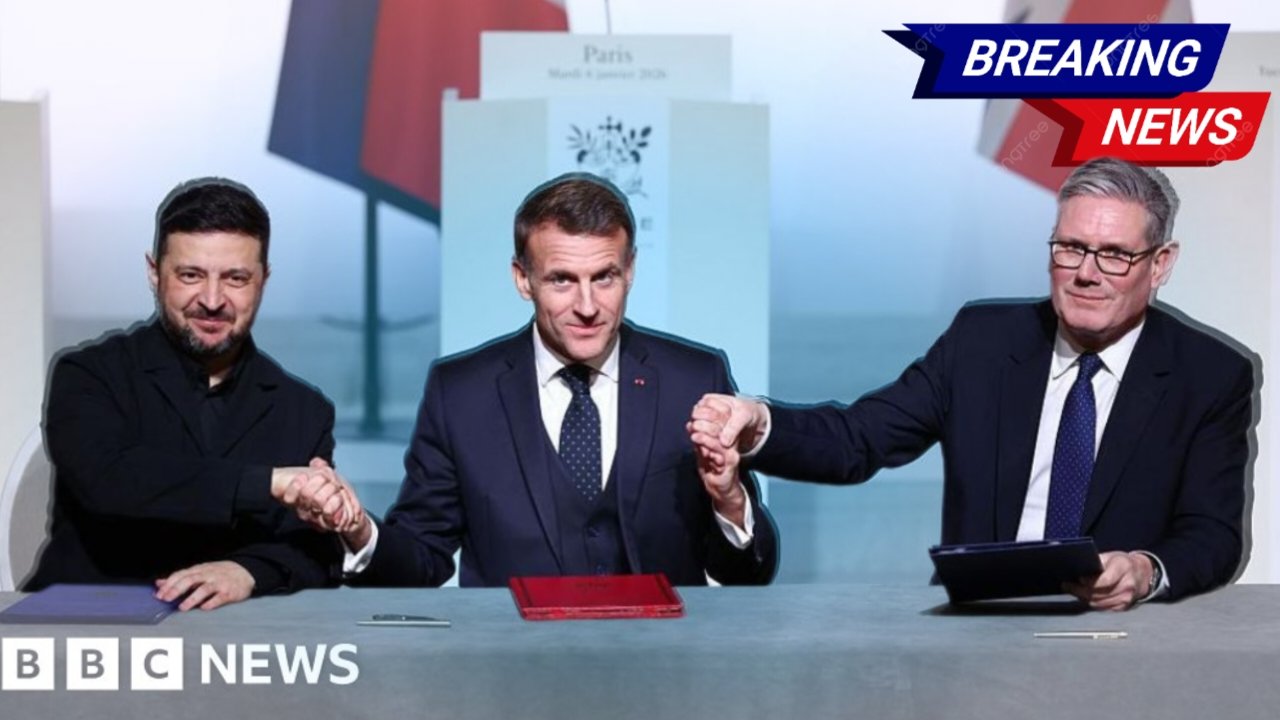
UK and France Prepare to Deploy Troops to Ukraine Following Potential Peace Deal
The landscape of the conflict in Ukraine has shifted dramatically this week following a high-stakes summit in Paris. In a move that signals a hardening of European resolve, the United Kingdom and France have signed a landmark “declaration of intent” to deploy military forces to Ukrainian soil. This deployment, however, is contingent on a formal ceasefire and peace agreement being reached between Kyiv and Moscow.
British Prime Minister Keir Starmer, alongside French President Emmanuel Macron and Ukrainian President Volodymyr Zelenskyy, announced the plan following a meeting of the “Coalition of the Willing”—a group of 35 nations dedicated to Ukraine’s long-term security. The proposal represents the most significant commitment of Western “boots on the ground” since the full-scale invasion began in 2022, marking a new chapter in the West’s strategy to deter future Russian aggression.
The Paris Declaration: What We Know So Far
The agreement signed in Paris is not an immediate deployment order but a legal and political framework designed to be activated the moment a peace deal is signed. According to Downing Street, the primary objective of these UK and French forces will be to provide “security guarantees” that prevent Russia from simply using a ceasefire to re-arm and attack again.
The mission is described as a “reassurance force.” Unlike the active combat roles currently seen on the front lines, these troops would likely focus on several key areas:
- Establishing “military hubs” across Ukraine to facilitate training and logistics.
- Protecting critical infrastructure and facilities for weapons and equipment.
- Conducting “deterrence operations” to monitor the ceasefire.
- Securing Ukraine’s skies and maritime interests in the Black Sea.
While President Macron has mentioned the possibility of “several thousand” French troops, the UK government has been more cautious regarding specific numbers. Prime Minister Starmer has stated that the exact size of the British contingent will be determined by military planning currently underway and will be subject to a vote in the House of Commons.
Security Guarantees: Breaking the Cycle of Failed Ceasefires
For years, many in the West and in Kyiv have argued that a peace deal without a robust enforcement mechanism is worthless. Memories of the failed Minsk agreements, which were frequently violated between 2014 and 2022, loom large over the current negotiations. This time, the “Coalition of the Willing” aims to create a “tripwire” effect.
By placing British and French soldiers in “hubs” throughout the country—even if they are not on the immediate front line—the West is raising the stakes for the Kremlin. Any future Russian incursion would risk direct conflict with NATO’s two nuclear-armed European powers. President Zelenskyy hailed the progress as a “huge step forward,” noting that for the first time, concrete documents and commands are being established rather than vague promises of support.
The Role of the United States and the “Coalition of the Willing”
The summit also highlighted a complex but crucial alignment with the United States. While the UK and France are leading the charge on ground troop commitments, the US is expected to provide the technological backbone of the peace monitoring. US envoys, including Jared Kushner and Steve Witkoff, indicated that Washington is prepared to lead a “ceasefire monitoring and verification mechanism” using advanced drones, sensors, and satellite surveillance.
Interestingly, the US has clarified that it does not intend to send its own ground troops to Ukraine. This leaves the “heavy lifting” of a physical presence to the Europeans, specifically London and Paris. This division of labour suggests a new model of Western security: American “eyes and ears” in the sky, backed by European “boots” on the ground.
Political Reactions and the Road to Westminster
The announcement has already sparked a heated debate in British politics. During Prime Minister’s Questions (PMQs), Keir Starmer faced pressure from Conservative leader Kemi Badenoch and Reform UK’s Nigel Farage regarding the lack of immediate transparency and the potential risks of the mission.
The Prime Minister has promised that if the situation moves toward an actual deployment, a full debate and vote will be held in Parliament. “I will be clear with the house that there would only be deployment after a ceasefire,” Starmer told MPs. “It would be to support Ukraine’s capabilities, to conduct deterrence operations, and to protect military hubs.”
Opponents of the plan, such as Nigel Farage, have raised concerns about the British Army’s current capacity. Recent figures show the size of the British Army has fallen to roughly 70,300, its lowest level in over two centuries. Critics argue that committing thousands of troops to an open-ended peacekeeping mission in Ukraine could overstretch an already depleted military.
Moscow’s Warning and the Risks of Escalation
Unsurprisingly, the Kremlin has reacted with predictable hostility to the news. Russian President Vladimir Putin has previously stated that any foreign troops on Ukrainian soil would be considered “legitimate targets.” Moscow maintains that it will not accept a ceasefire that includes the presence of NATO forces.
This creates a significant diplomatic hurdle. For a peace deal to be “agreed,” Russia would essentially have to drop its long-standing objection to a Western military presence in Ukraine. Some analysts suggest that the UK and France are making this commitment now to strengthen Ukraine’s hand at the negotiating table, showing Putin that his “war of attrition” will eventually be met by a permanent Western military barrier.
The Multinational Force: A New Peacekeeping Era?
The proposed force is currently estimated to be between 10,000 and 15,000 strong. While this is modest compared to historical peacekeeping missions—such as the 60,000-strong NATO force in Bosnia in the 1990s—the strategic value lies in its composition. As the only two nuclear powers in Western Europe, the UK and France carry a weight that other nations do not.
Other allies have shown varying levels of support. Germany’s Chancellor Friedrich Merz suggested that German forces might be deployed to NATO territory neighbouring Ukraine to free up other nations’ resources, but Berlin remains hesitant to put boots directly inside Ukraine. Poland and Italy have also expressed reservations about ground deployments, making the Anglo-French leadership of this “Coalition” even more critical.
What Happens Next?
Despite the “excellent progress” cited by Starmer, a peace deal is not yet a reality. President Zelenskyy noted that while the framework is 90% ready, the remaining 10%—which includes Russia’s withdrawal and the status of occupied territories like the Donbas—remains the hardest part.
The next few months will be critical. The British Ministry of Defence will continue to refine its operational plans, while diplomats in Paris and Washington attempt to find a breakthrough that the Kremlin might actually sign. For now, the message from London and Paris is clear: they are no longer just sending weapons; they are preparing to send their soldiers to ensure that when the guns finally fall silent, they stay silent.
Would you like me to monitor the latest updates on the parliamentary debate regarding this troop deployment?